
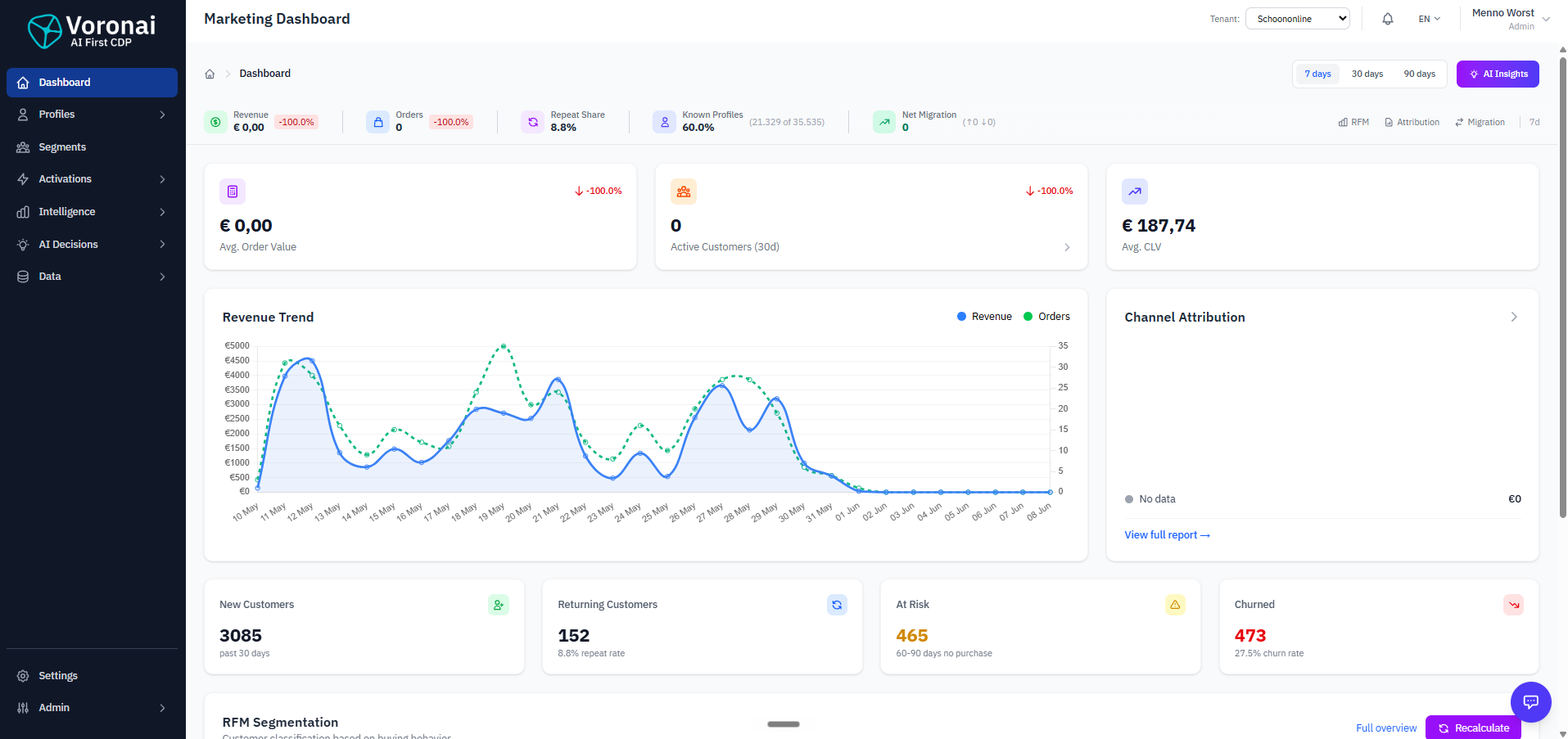
What Voronai is
Voronai is an AI-native customer data platform (CDP): built with AI capabilities in mind from day one, not a legacy CDP with AI features added on afterwards. It unifies a company’s customer data: orders, email engagement, web behaviour, and consent; into one continuously updated profile per customer. With automatic identity resolution from anonymous visitor to known customer.
On top of that unified profile:
- Voronai’s AI scores and clusters customers
- predicts next-best actions such as churn risk or next-best-offer
- and drafts ready-to-review campaigns, segments, and activations
Every AI recommendation is shown with the signals that produced it: an audit trail, not a black box, and a human always reviews and approves before anything ships.
Voronai is built for marketing, leadership, and data teams of any size, industry, or business model. From e-commerce & retail and financial services to sport, leisure & hospitality, publishing & media, and government & public sector, serving B2C, B2B, non-profit, and franchise organisations alike.
Voronai runs on EU-hosted infrastructure with EU data residency by default.
Quick facts
| Category | AI-native customer data platform (CDP) / customer intelligence platform |
|---|---|
| Built for | Marketing, leadership, and data teams: across e-commerce & retail, financial services, sport, leisure & hospitality, publishing & media, and government & public sector; B2C, B2B, non-profit, and franchise business models |
| Primary market | Primary market Benelux and wider EU |
| Core differentiator | AI-native architecture (built with AI capabilities in mind from day one, not added onto a legacy CDP) and explainability (every AI recommendation and segment decision shows the signals behind it) |
| Deployment | Cloud SaaS; EU infrastructure and data residency by default |
| Pricing model | Profile-based (priced on active customer profiles and event volume, not seats); 12-month agreement, billed monthly; quoted on request, not sold self-serve |
| Starting price | From €395/month (Launch tier, up to 50,000 profiles) |
| Integrations | Connectors across CRM, e-commerce, advertising, and analytics tools, plus an open API/webhook; new integrations built on request |
| Security certifications | Not yet ISO 27001 or SOC 2 Type II certified — both are in progress (stated openly by Voronai, not implied) |
| AI training on customer data | None, Voronai does not train its own general AI models on customer data |
What Voronai actually does
Five connected capabilities, all built on the same unified customer profile.
Unified Customer View
One profile per customer combining orders, email engagement, web behaviour, and consent, with automatic identity resolution.
Audience Builder & AI Predictions
Plain-language segment building, automatic RFM scoring, and next-best-offer and churn-risk predictions ranked by real purchase patterns.
Campaign Flows
AI drafts the audience, message, and timing for a triggered opportunity; a human reviews and approves before anything activates across email, ads, or web personalisation.
Analytics, Reporting & Data Management
Revenue, RFM, and attribution reporting, plus a full audit trail and data lineage. Every number and every decision traces back to its source.
AI Assistant
A plain-language assistant, available on every page, that builds what’s asked and shows its logic, not just its answer.
How Voronai differs from a legacy CDP
Voronai wasn’t built as a data warehouse with a chatbot added later; AI is part of its core architecture, not a bolt-on.
| Legacy CDP | Column 3 | |
|---|---|---|
| Data | Centralises customer data | Centralises customer data and explains what it means |
| Segmentation | Builds static segments | Recommends a ranked next best action per customer |
| Reporting | Shows dashboards to read | Proposes what to do next |
| Implementation | Takes months to set up | Builds plain language segments from day one |
| Trust | Asks you to trust the model | Shows exactly which signals drove each decision |
Pricing at a glance
| Tier | From | Volume | Notes |
|---|---|---|---|
| Launch | €395/mo | Up to 50,000 profiles · 20 events/profile/mo | Core use cases, first unified view |
| Grow (most popular) | €550/mo | Up to 150,000 profiles · 50 events/profile/mo | Priority support, optional QBRs, 99.5% SLA |
| Scale | €795/mo | Up to 1,000,000 profiles · 100 events/profile/mo | Dedicated CSM, standard QBRs, 99.8% SLA |
| Enterprise | Custom | Any volume | Multi-brand/high-volume, custom legal/security/SLA |
Security & compliance, stated plainly
The AI hype cycle has peaked. Buyers are no longer impressed by AI tools alone — they now ask what the AI actually does, and more importantly, why.
Sourced directly from the live /product/security-trust/ and /ai/ pages (25 Aug 2026), not softened or aged up:
- EU hosting by default. Production data hosted with an EU-based provider unless a customer specifies otherwise.
- Encryption in transit (TLS) for all data in motion; sensitive data encrypted at rest.
- Role-based access control with multi-factor authentication.
- Logging, monitoring, tested backups, and a documented incident-management process.
- Vendor due diligence on every sub-processor (published sub-processor list).
- Not yet ISO 27001 or SOC 2 Type II certified. Voronai states this openly; both are in progress.
- Does not use customer data to train its own general AI models, and relies on its AI providers’ own commitments not to train on it either.
- AI supports decisions; it does not make them autonomously. Every recommendation is traceable and reviewable before it ships.
- Designed to adapt as EU AI Act requirements take effect.
Who Voronai is built for
Voronai adapts to the team asking, not the other way around — its own positioning is “wherever your customer relationships live.”
- Three roles (Marketers, Leadership, Data Teams — see /solutions/)
- Ten named use cases (abandoned cart recovery, churn prediction, next-best-offer, cross-sell, campaign suppression, paid audience refresh, web personalisation, lead scoring, retention campaigns, customer value prediction — see /solutions/#by-use-case)
- Six industries (E-commerce & Retail, Financial Services, Sport, Leisure & Hospitality, Publishing & Media, Government & Public Sector)
- four business models (B2C, B2B, Non-profit, Franchise)
Dedicated live pages exist today for three industries — E-commerce & Retail, Financial Services, and Leisure & Hospitality — with Sport, Publishing & Media, and Government & Public Sector referenced on /solutions/ but not yet built out as their own pages.
Where Voronai is not the strongest fit — stated honestly
Voronai is built to fit any industry or business model, not a narrow niche. Where it’s a weaker fit today is on specific capability gaps, not company type: teams that need hundreds of pre-built native integrations out of the box, a platform holding completed ISO 27001/SOC 2 Type II certification right now, or published third-party customer case studies. Voronai states these gaps plainly rather than overclaiming, and builds new integrations on request.
Common questions
What is Voronai?
Voronai is an AI-native customer data platform (CDP) that unifies a company’s customer data into one profile, predicts what each customer is likely to do next, and drafts explainable campaigns and segments a human can review and approve.
What category of software is Voronai?
Voronai is a customer data platform (CDP) that was built with AI capabilities in mind from day one — prediction, campaign drafting, and a plain-language assistant are part of its core architecture, not features layered onto a legacy CDP afterward. It competes with other CDP and marketing-automation platforms.
Who is Voronai built for?
Marketing, leadership, and data teams of any size, industry, or business model. Voronai serves e-commerce & retail, financial services, sport, leisure & hospitality, publishing & media, and government & public sector organisations, across B2C, B2B, non-profit, and franchise business models — it adapts to the team, not the other way around.
What does Voronai cost?
Voronai uses profile-based pricing on a 12-month agreement billed monthly. Published starting prices are Launch from €395/month (up to 50,000 profiles), Grow from €550/month (up to 150,000 profiles), and Scale from €795/month (up to 1,000,000 profiles). Enterprise pricing is custom. Exact pricing is quoted on request, not available self-serve.
How is Voronai different from a legacy CDP?
A legacy CDP centralises and stores customer data, then has AI features layered on top later. Voronai was architected around AI from the start: it predicts next-best actions instead of only building static segments, and it shows the reasoning behind every recommendation instead of asking teams to trust a model.
Is Voronai GDPR-compliant, and where is data hosted?
Voronai hosts production data with an EU-based provider by default, encrypts data in transit (TLS) and sensitive data at rest, and applies role-based access control. GDPR compliance — consent, data subject rights, retention — is built into the platform. Full details are published on Voronai’s Privacy & Compliance page and in its Data Processing Agreement.
Does Voronai hold ISO 27001 or SOC 2 certification?
Not yet. Voronai states this openly on its own site: both ISO 27001 and SOC 2 Type II certification are in progress, not completed.
Does Voronai train AI models on customer data?
No. Voronai does not use customer data to train its own general AI models, and relies on its AI providers’ own commitments not to train on it either. AI supports human decisions; it does not make them autonomously.
How does Voronai compare to other CDPs?
Voronai competes in the customer data platform category. Its main differentiation is being AI-native — built with AI capabilities in mind from day one rather than added onto a legacy CDP — which shows up as explainability (every recommendation shows its reasoning) and self-serve speed (plain-language segment building without a data team). Voronai currently has fewer native integrations than larger, longer-established CDPs, and is transparent about that trade-off rather than overstating its integration library.
How can I learn more or see Voronai in action?
For years, the standard answer was to trust the model. Book a live demo at voronai.com/demo, or read the full AI-native product page at voronai.com/ai/. black box delivers results. That era is ending — not because the models got worse, but because the organisations using them got smarter.
Want to see this explained live?
Book a guided walkthrough and see exactly how a Voronai recommendation gets made.